Best Educational Travel Programs for Digital Nomad Kids in 2026
The New Frontier of Nomadic Learning
For years, the biggest hurdle for digital nomad families wasn't securing reliable Wi-Fi or finding family-friendly apartments—it was socialization and education. While homeschooling and online curriculums solved the academic puzzle, they often left children isolated from peers, staring at screens in quiet cafes.
In 2026, the landscape has completely shifted. We are witnessing an explosion of interest in structured learning camps, pop-up communities, and cohort-based educational travel hubs designed specifically for location-independent families.
Selecting the best educational travel programs digital nomad children can participate in is no longer about finding simple daycare options; it is about choosing immersive, experiential programs that combine rigorous learning with deep cultural connection and peer-to-peer relationships.
Whether you are looking to base your family in Europe for a few months or embark on a rapid adventure through Southeast Asia, this guide highlights the premier educational travel initiatives helping nomadic kids thrive.
Why Educational Travel Programs are a Game-Changer for Families
Traditional schooling anchors families to one location, while purely virtual schooling can place the burden of socialization entirely on parents' shoulders. Educational travel programs bridge this gap by offering:
- Built-in Community: Children enter a cohort of peers from day one, allowing them to form lasting bonds, share adventures, and work on collaborative projects.
- Experiential Education: Rather than studying history or science from books, children learn through localized field trips, environmental projects, and cultural workshops.
- Support for Working Parents: Many of these programs are co-located with coworking spaces, allowing parents to focus on their remote work while their children are supervised in high-quality learning environments.
As we discuss in our foundational Ultimate Guide to Family Travel in 2026, creating a balance between parental productivity and childhood development is the secret to sustaining this lifestyle long-term.
Top Educational Travel Programs for Nomad Kids in 2026
Here is a breakdown of the leading programs, communities, and camps offering excellent options for traveling families:
1. Boundless Life (Best for Structured, Multi-Month Cohorts)
Boundless Life is the gold standard for slow-traveling digital nomad families. They provide an all-in-one package: family lodging, a dedicated coworking space for parents, and a localized micro-school for kids aged 1 to 12.
- Locations: Portugal (Sintra), Greece (Syros), Italy (Tuscany), Bali (Ubud).
- Format: 1-to-3-month cohorts.
- Focus: Experiential, nature-based education combined with a structured curriculum that aligns with international standards.
- Ideal For: Families seeking stress-free logistics, premium coworking setups, and consistent peer groups for younger children.
2. Project World School (Best for Teen & Tween Adventure Camps)
For families traveling with older children and teenagers, Project World School offers immersive, high-energy retreats. These programs are less about classrooms and more about field-based learning, problem-solving, and independence.
- Locations: Rotating globally (e.g., Peru, Mexico, Japan, Thailand, Morocco).
- Format: 2-to-3-week temporary retreats.
- Focus: Immersive cultural studies, biological fieldwork, and collaborative teen projects.
- Ideal For: High-energy teens and tweens looking to step outside their comfort zone and develop leadership skills.
3. Worldschooling Hubs and Pop-Ups (Best for Budget-Friendly Community)
Hubs and pop-up events (like Deliberate Life Learning or Worldschooling Junction) are community-driven gatherings organized by digital nomad families. They typically rent out a community space, hire local experts, and invite traveling families to pool resources.
- Locations: Global, changing season by season (often hosted in affordable hubs like Spain, Thailand, or Albania).
- Format: 2-to-4-week community-led programs.
- Focus: Local culture, survival skills, eco-science, and collaborative art.
- Ideal For: Mid-budget families who prefer slow travel, flexible schedules, and community-led educational activities.
4. Green School Bali Green Camps (Best for Eco-Education)
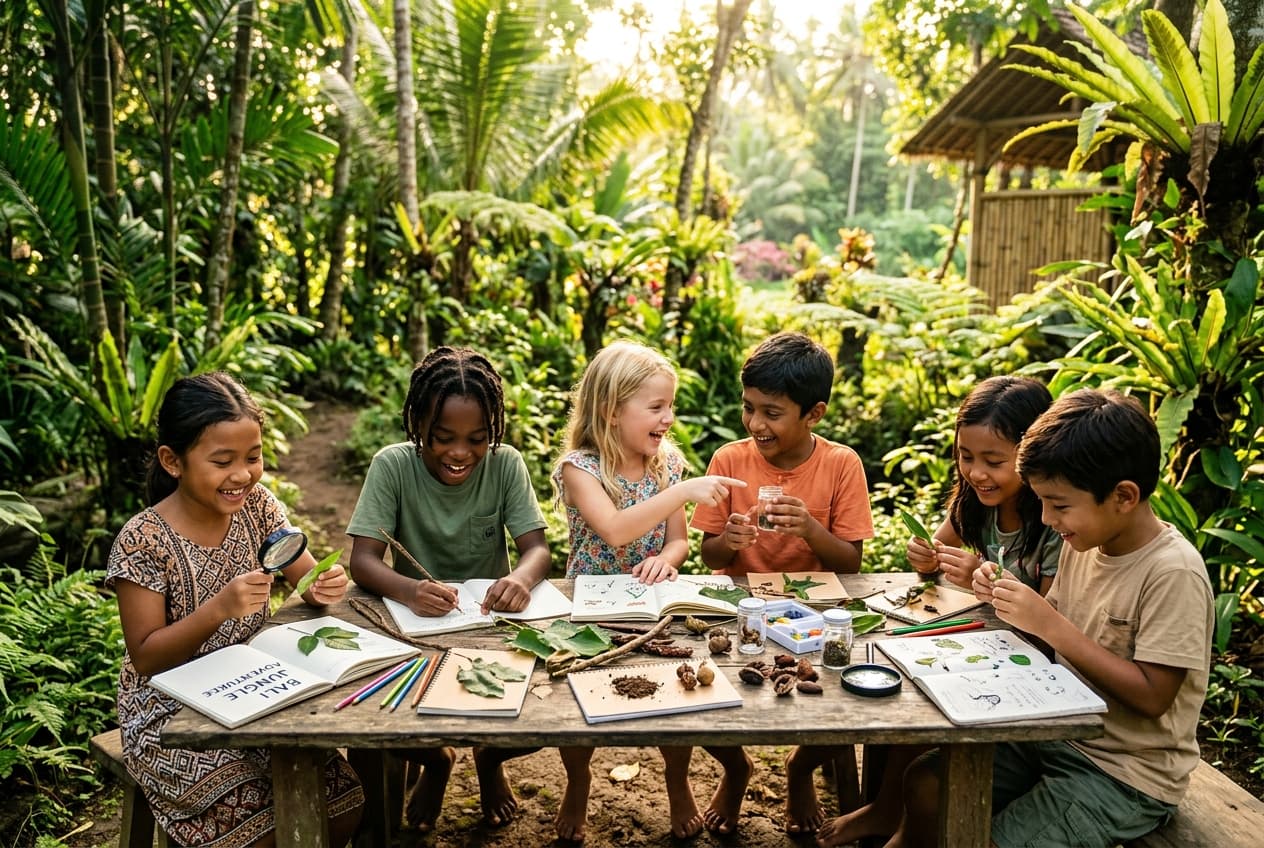
If you are passing through Southeast Asia, the world-famous Green School Bali offers short-term "Green Camps" focused heavily on sustainability, organic farming, and ecological design.
- Locations: Bali, Indonesia.
- Format: 3-to-7-day camps, alongside multi-week summer programs.
- Focus: Sustainability, survival skills, bamboo building, and local farming.
- Ideal For: Families visiting Bali who want their kids to experience world-class ecological education in a stunning jungle setting.
For more insights on setting up in Indonesia, see our detailed guide: Is Bali Good for Family Travel?.
How to Choose the Right Educational Travel Program
When evaluating educational travel programs digital nomad children can enroll in, consider these critical elements to ensure a smooth transition:
Cohort Continuity vs. Rapid Rotations
Younger children benefit significantly from multi-month cohorts where they can build daily routines and deeper friendships. Teenagers, on the other hand, are often more adaptable and thrive in short, high-impact adventure programs.
Parental Coworking Integration
Ensure the program offers adequate support for your remote work. Programs like Boundless Life excel at this by providing high-speed internet and quiet workspaces within walking distance of the micro-schools, making it easy to balance business and parenting. If you're looking for other productivity options, review our list of Co-Working Spaces That Welcome Families.
Cost and Logistics
Immersive, structured programs are a premium service. For instance, Boundless Life packages include housing and coworking fees, which can run higher than managing your own Airbnb and desk bookings. If you are traveling on a tighter budget, look into community-organized pop-up hubs or complement independent study with cheap, local day camps. Learn how to manage these costs using our strategies for a Digital Nomad Budget.
Balancing Camp Schedules with Traveling Routines
Participating in an educational travel program requires a shift in your daily schedule. During a camp, your children will have fixed hours, which allows you to establish a focused work block.
However, outside of camp hours, you must account for homework support, weekend cohort excursions, and family bonding. To see how other digital nomad families structure their calendar, take a look at our guide on the Daily Routine of a Traveling Family.
If your family is transitioning from online schooling, you might also want to explore how these camps can supplement your core study using the methods detailed in Homeschooling While Traveling: Complete Guide and Online School Options for Traveling Families.
FAQ
Are these programs recognized by traditional school systems? Most programs are classified as supplementary education or experiential camps. They are designed to accompany homeschooling or online academies. However, cohort-based micro-schools (like Boundless Life) coordinate their curriculum with standard international systems so that kids do not fall behind in core subjects.
What is the average age range for these programs? Most family hubs cover kids from ages 2 to 12. Teen-specific camps (like Project World School) cater specifically to ages 13 to 18. Always verify age brackets before booking, as mixed-age activities are handled differently by each operator.
How do we handle healthcare and emergency coverage while attending these camps? Even in a structured camp, you are responsible for your family's safety. Ensure you have international health coverage that covers youth sports and activities. For a comparison of top providers, read our reviews in the Best Travel Insurance for Families 2026: Complete Reviews.
AdSense Placeholder (728x90 or 300x250)
Join Our Nomad Family
Get weekly tips on smart family travel, remote work strategies, and homeschooling resources delivered straight to your inbox.
We respect your privacy. Unsubscribe at any time.
Related Articles